U.S. and
Canada
U.S. and
Canada







 Pasternack Blog
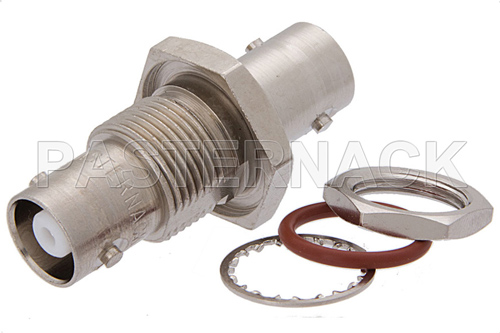 A hermetically sealed enclosure, or hermetic packaging, is a method of encapsulating a device or system in an environmentally protected package that prevents the exchange of the inside and outside environment. Hermetic packages are commonly seen in automotive, industrial, naval, military, and aerospace applications where the outside environment may lead to damage, early failure, or derating of internal system components. Many High Reliability (Hi-Rel) applications require hermetic sealing of critical RF/microwave components, devices, and assemblies.
Common environmental contaminants include dust particles, water vapor, salt fog, corrosive chemicals, and other harmful gases and liquids. RF coaxial connectors, waveguide, semiconductors, monolithic microwave integrated circuits (MMIC), microelectromechanical machines (MEMS) devices, and sensors are often hermetically sealed to maintain high performance and reliable operation. In many cases hermetic packaging is chosen as a reliable method of preventing environmental contamination, even though it adds substantial size, weight, and cost to components, devices, and assemblies. It is required by many military, naval, and aerospace standards to use hermetic packaging for certain applications. These standards also include rigorous methods for determining the hermeticity of a seal or enclosure, typically using a helium leak rate as specified in MIL-STD-883C.
There are non-hermetic packaging methods of environmental protection being evaluated to overcome some of the challenges of hermetic packing RF, microwave, and millimeter-wave elements. In the case of extremely harsh environmental factors, hermetic enclosures are often the only method rigorous enough to protect critical electronics. In some cases, it is also important for the enclosure to prevent gases and particles from within a hermetic enclosure from escaping. This is especially true for space systems, such as satellites, where stray gases and particles from can inadvertently lead to system degradation as gases and particles react, deposit, settle, cloud, or otherwise interact with other sensitive systems or interconnect.
Hermetically sealed RF/microwave components and devices can readily be found, or components and devices compatible with hermetic enclosure, such as coaxial connectors and waveguides. In some applications, it may be worthwhile to hermetically enclose each component or device in it’s own package and use an interconnect that is able to maintain the hermeticity of the packages. In other cases, generally to reduce size, weight, cost, and other signal quality degradation factors, several components and devices are placed in a sub-assembly, or assembly, and hermetically enclosed within.
As the demand for uninterrupted connectivity grows, the principles behind these high-reliability aerospace packages are increasingly being adapted for terrestrial telecommunications. Remote cellular base stations and edge computing nodes often operate in environmentally unforgiving locations—from coastal towers battered by continuous salt fog to desert installations exposed to extreme thermal cycling and fine particulate dust. To ensure continuous network operation, hardware engineers are borrowing hermetic and semi-hermetic packaging strategies to shield sensitive commercial RF transceivers from the elements.
The commercial incentive to deploy this level of military-grade protection is driven entirely by the extreme cost of network downtime. Today’s digital ecosystem relies on instantaneous, uninterrupted data transmission across decentralized hardware. Financial institutions executing high-frequency trades, international streaming platforms delivering live content, and global betting sites processing thousands of concurrent micro-transactions all require edge infrastructure that will not fail during severe weather events or environmental exposure. For these enterprise operators, the substantial upfront cost of ruggedized, environmentally sealed telecom enclosures is vastly outweighed by the revenue protected during peak traffic moments.
However, adapting traditional hermetic sealing techniques for commercial telecom infrastructure presents unique engineering challenges. Unlike a satellite operating in the vacuum of space, these terrestrial enclosures must manage the immense thermal loads generated by densely packed commercial processors. Engineers are actively developing advanced composite materials and specialized glass-to-metal seals that maintain strict environmental isolation while offering superior thermal dissipation, bridging the gap between bespoke military defense hardware and highly scalable commercial network deployments.
Learn more about Pasternack’s extensive line of hermetically sealed components and devices: https://www.pasternack.com/nsearch.aspx?keywords=hermetic&view_type=grid