U.S. and
Canada
U.S. and
Canada







 Pasternack Blog
In reality, all types of RF antennas have some degree of directionality. However, there are certain antenna designs and types that are particularly directional compared to other antenna types. A Directional Antenna is useful in applications where it is desirable to receive a signal from a specific direction of origin or otherwise transmit a signal in a specific direction. The directivity of an antenna is judged based on how much of the input energy into the antenna is channeled into the primary direction of the antenna. In theory, an absolutely directive antenna would send virtually all of the signal energy in a single straight line, minus interconnect and antenna losses.
Key Takeaways
- • A directional antenna concentrates RF energy in a specific direction, enabling stronger signal reception/transmission and reduced interference compared to omnidirectional antennas.
- • Real-world directional antennas are never perfectly focused; their performance is constrained by design, construction, and operating frequency.
- • The size of a directional antenna is proportional to the operating wavelength: lower frequencies ⇒ physically larger antennas for the same beam width/gain.
- • Popular directional antenna types include panel/patch antennas (for cellular/backhaul), Yagi antennas (for ISM/point-to-point), and horn antennas (for test and measurement and mmWave).
- • Key specifications to compare include gain (dBi), beam width, frequency range, polarization, front-to-back ratio, and environmental/installation factors like mounting and size.
- • For long-distance point-to-point links (e.g., backhaul, mmWave), directional antennas offer high gain and narrow beams to maximise signal strength and minimise interference or multipath.
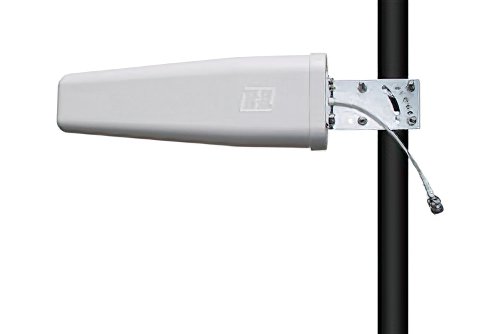
However, no real directional antenna is ideal, and the directivity is ultimately limited by the design and construction of the antenna. Moreover, directional antennas operate in a limited frequency range where they are most direct. Some types of directional antennas are very limited in bandwidth, while there are other designs that have broad bandwidths, but there are often trade-offs in size, weight, efficiency, design complexity, and/or cost to achieve these performance goals. As with most RF passive components and active devices, the relative size of directional antennas is proportional to the operating frequency range of the antenna, with higher frequency antennas being proportionally smaller than lower frequency antennas.
An example of where directive antennas are used are to receive the very weak signals from geo navigation systems, such as GPS Antennas. Other examples include point-to-point microwave and millimeter-wave backhaul links and during various forms of testing, including electromagnetic compatibility testing. Panel and Patch Antennas are directional antennas often used with cellular and wireless telecommunications and backhaul applications due to their slim profiles and high directivity. Yagi Antennas are another common type of directional antenna that are often used for ISM band applications, and many other industrial, SCADA, scientific, and medical purposes.
Gain Horn Antennas are a type of highly direction waveguide antenna, of which there are many types. Some waveguide gain horn antennas have a coaxial-to-waveguide adapter integrated into the antenna, while others use standard sized waveguide inputs. It is important to note that waveguide gain horn antennas, even with coaxial ports, are limited in frequency range to the waveguide size, with the exception of broadband waveguide horn antennas, which are specifically designed for optimal bandwidth. Gain Horn Antennas are often used in test and measurement applications and are often used to measure the performance of other antennas for certification, compliance, or other measurement applications.
FAQs (Frequently Asked Questions)
Q1. What is a directional antenna?
A: A directional antenna transmits and receives radio frequency (RF) signals more effectively in a single direction rather than radiating equally in all directions. This focused radiation pattern allows for longer range, higher gain, and reduced interference.
Q2. What are the main types of directional antennas?
A: Directional antennas come in several designs based on application and frequency range:
- • Yagi Antennas: Ideal for long-range point-to-point wireless communication
- • Panel/Patch Antennas: Common Wi-Fi networks, cellular base stations, and fixed wireless systems
- • Horn Antennas: Used in high-frequency and microwave testing environments
- • Parabolic Dish Antennas: Offer high gain for satellite and radar systems
Q3. What is the difference between directional and omnidirectional antennas?
- • Directional antennas focus energy in one direction, resulting in higher gain and longer range but narrower coverage
- • Omnidirectional antennas radiate uniformly in all directions, covering a wider area but offering lower gain.
Directional antennas are preferred for targeted communication links, such as point-to-point or backhaul systems
Q4. How does antenna gain affect performance?
A: Higher antenna gain focuses more power on a particular direction, improving signal strength and link distance. However, this reduces the beamwidth, meaning careful alignment is crucial for optimal performance.