U.S. and
Canada
U.S. and
Canada







 Pasternack Blog
By Kevin Hietpas
The industrial, scientific and medical (ISM) radio frequency bands are designated radio frequency bands as defined by the International Telecommunication Union (ITU) Radio Regulations. These bands were originally set aside for RF use purposes other than telecommunications. Much of their usage is now for low-power wireless communications.
Key Takeaways
- ● ISM bands are specific RF frequency ranges reserved by the International Telecommunication Union (ITU) primarily for industrial, scientific, and medical uses. Still, today, many wireless communication systems also operate in them.
- ● Because ISM-band frequencies are license-free (in many jurisdictions) for low-power, short-range systems, they are widely used for technologies such as WiFi (2.4 GHz), Bluetooth, Zigbee, RFID, and NFC.
- ● Using ISM bands for communications means devices must be designed to tolerate interference from other users (e.g., microwave ovens, RF heating systems) since the band is shared and not exclusively for telecom.
- ● For system design in IoT, wireless, industrial automation, or consumer electronics, knowing the ISM bands helps with frequency planning, regulatory compliance, and interference mitigation.
Withstanding Frequency Interference
While use of the ISM bands for telecommunications has expanded, so too has the requirement to “play well with others”—to withstand the interference from other RF and microwave technologies such as microwave ovens, RF heating and other devices that could produce electromagnetic interference (EMI). While the ITU determines the international band designations, individual countries’ exact ISM band frequencies may differ.
ISM Band Uses Outside Communications
Though originally set aside for non-communication purposes, many short-range, low -power, license-free or unlicensed error-tolerant communications systems operate within the ISM bands. The most common uses outside of communications are:
- ● Induction heating for industrial and home applications
- ● Microwave heating for industrial and home applications
- ● RF and microwave heating for medical purposes, such as diathermy hyperthermia therapy, and RF/microwave ablation.
Also, radar systems have been developed recently that operate in the ISM bands, specifically 2.4 GHz, due to the readily available and inexpensive wireless integrated circuits (ICs) available for these frequencies.
Use of ISM Bands in Telecom
The most common everyday uses of the ISM bands are for low-power and short-range telecommunications. Examples include Wi-Fi, Bluetooth, Zigbee, wireless telephones, radio-frequency identification (RFID) and near-field communication (NFC). Applications include theft sensors in stores, inventory tracking in warehouses and EZ Pass/toll pass applications. Retail stores are using it to expedite self checkout and reduce checkout time and theft. Uses encompass wherever a customer touches or almost touches to transfer information, such as keycard readers and badges, contactless payments, tap-to-share contact info, etc.
Many in the U.S. are familiar with the 2.4 GHz ISM band, as most Wi-Fi and Bluetooth communications operate in this band, though 5 GHz Wi-Fi systems have become more available recently, and even the non-ISM band 6 GHz for Wi-Fi. There are also many common RFID and NFC systems that use 13.56 MHz in the 13.553 MHz to 13.567 MHz ISM band. Numerous credit cards, secure access, personnel identification and wireless payment systems use these technologies.
Use of Zigbee and WiGig
Moreover, many of the latest smart home and hobbyist electronics use Zigbee technology in the 915 MHz and 2.4 GHz ISM bands for low-power and short-range communications between devices. In the next few years, it is likely that 60 GHz Wi-Fi (WiGig, known as IEEE 802.11ad), operating in the 60 GHz ISM band, will gain popularity for extremely high throughput device-to-device communication. Some examples of this application may be high definition, 4K, video streaming and extremely fast device-to-device wireless data transfers.
Effects of IoT and Industry 4.0
Many more modulation schemes and communication platforms targeted for ISM bands have emerged in the past few years. Some of the reasons for this could be the increased potential of the Internet of Things (IoT), where ISM bands are prevalent, and Industry 4.0 applications, which will likely rely on low-power and short-range machine-type communications without users being directly involved. Examples of these new technologies include Thread, Matter, Z-Wave and LoRa/LPWAN. Though future applications of ISM bands may include satellite communications, right now there are no ISM bands available for current CubeSats, nanosats or other smallsats.
ISM Bands for Medical Devices
ISM bands are now being used more for medical devices than for medical communications. The ISM bands are suitable for interacting with the human body; water cells react at 2.4 GHz. Higher bands, like 61 GHz, are used for millimeter-wave imaging (body scans), noninvasive breathing monitors, heartrate monitors, imaging of tumors and active position markers for guided MRI.
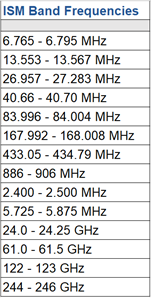
To find products by frequency range, just enter your desired frequency range into the Pasternack site search.
FAQs (Frequently Asked Questions)
Q1: What are ISM bands?
A: ISM bands are frequency ranges set aside by the ITU for industrial, scientific, and medical applications; however, they are also widely used for license-free wireless communication devices under regulated conditions.
Q2: Why do many WiFi and Bluetooth systems use ISM bands?
A: Because these bands allow unlicensed operation for low-power wireless devices, making them ideal for short-range communication and mass-market adoption.
Q3: Do ISM band devices need a licence?
A: In many regions, devices in ISM bands can operate under licence-exempt rules, but they must meet specific technical limits (e.g., power, duty cycle, spurious emissions) and tolerate interference from other users.
Q4: What is a common example of the use of ISM bands?
A: The 2.4 GHz ISM band is used by WiFi 802.11 (b/g/n), Bluetooth, Zigbee, and many IoT sensors because the band is globally available (though regulations vary).
Q5: Are there limitations when using ISM bands?
A: Yes, interference is often more prevalent because of many devices sharing the band; certain frequencies may have regulatory restrictions or regional differences; and high-power communication over ISM bands may be more challenging due to these constraints.